

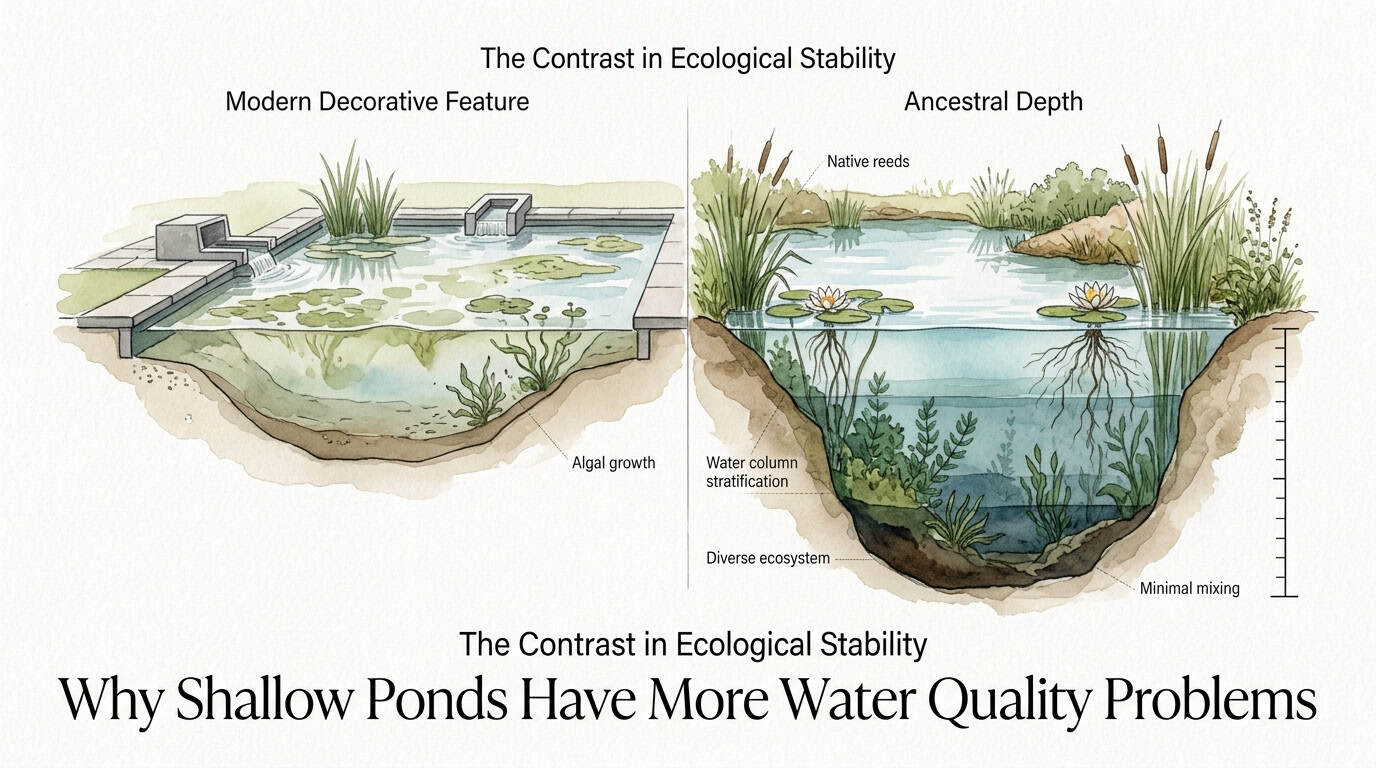
Shallow ponds experience significantly more water quality problems because they lack the thermal mass required to buffer against rapid temperature fluctuations. High water temperatures directly reduce dissolved oxygen solubility while simultaneously accelerating the metabolic rates of fish and bacteria, leading to rapid oxygen depletion. Furthermore, increased light penetration to the pond floor facilitates excessive algal and weed growth, which further destabilizes the ecosystem through nocturnal respiration and organic muck accumulation.
Nature designed ponds to have depth for a reason. Modern landscaping favors shallow ‘features’, but ancestral wisdom knew that depth equals stability. Shallow water heats up too fast, losing oxygen and inviting muck. Here is how to fix the depth deficit.
Maintaining a stable aquatic environment requires a balance of physical and chemical parameters that are naturally easier to manage in larger volumes of water. Shallow water features often fail because they operate on a razor-thin margin of error. Minor environmental changes that a deep pond would absorb without consequence can trigger a total system collapse in a shallow one. This article explores the mechanical and biological reasons why depth is the most critical variable in pond longevity.
Why Shallow Ponds Have More Water Quality Problems
Shallow ponds are typically defined as bodies of water where the average depth is less than three feet. In these systems, the surface-area-to-volume ratio is disproportionately high. This geometric reality means that a large percentage of the total water volume is in constant contact with the atmosphere and solar radiation. Consequently, the water responds almost instantly to changes in ambient air temperature and sunlight intensity.

Water quality in these environments is primarily dictated by the relationship between temperature, dissolved oxygen, and nutrient concentrations. In a shallow pond, sunlight often reaches the entire benthic (bottom) surface. This creates a massive photic zone where photosynthesis can occur throughout the entire water column. While photosynthesis produces oxygen during the day, the sheer density of plant and algal life in shallow ponds leads to massive oxygen consumption at night through respiration, often resulting in “crashes” where dissolved oxygen levels drop below the threshold required for fish survival.
Furthermore, shallow ponds act as efficient “heat sinks.” Because they lack the cooler, denser bottom layers found in deeper ponds, the entire water column can reach temperatures that exceed 85°F (29°C) during summer months. At these temperatures, the water’s physical capacity to hold oxygen is nearly halved compared to cooler water, while the biological demand for that oxygen increases exponentially.
How It Works: The Mechanics of Depth and Stability
The stability provided by depth is rooted in the principles of thermodynamics and fluid mechanics. Understanding these processes explains why deep ponds remain clear while shallow ones turn into “pea soup.”
Thermal Mass and Specific Heat Capacity
Water has a high specific heat capacity, meaning it requires significant energy to change its temperature. However, in a shallow feature with low total volume, the energy provided by several hours of direct summer sun is sufficient to raise the temperature by 10 or 15 degrees. In a pond with five or ten feet of depth, that same energy is distributed throughout a much larger mass. The deeper layers remain insulated from the surface heat, providing a “thermal buffer” that prevents the entire ecosystem from overheating.
The Role of the Photic Zone
The photic zone is the depth to which sunlight can penetrate with sufficient intensity for photosynthesis. In many shallow ponds, the photic zone extends to the very bottom. This allows filamentous algae and submerged weeds to anchor and grow across the entire pond floor. In deeper ponds, the lower sections remain in darkness. This prevents bottom-dwelling plants from colonizing the entire basin, limiting nutrient uptake primarily to the surface or edges and leaving the deep water as a nutrient sink where organic matter can decompose more slowly in cooler temperatures.
Henry’s Law and Gas Solubility
Physical laws dictate that the solubility of a gas in a liquid is inversely proportional to the temperature. According to Henry’s Law, as pond water warms, its ability to retain dissolved oxygen (DO) decreases. For example, water at 50°F can hold approximately 11.3 mg/L of oxygen at saturation, whereas water at 86°F can only hold about 7.5 mg/L. Shallow ponds spend more time at these higher temperatures, meaning they are perpetually operating at a lower oxygen baseline, leaving very little “reserve” for periods of high biological activity.

Benefits of Increased Water Depth
Deepening a pond or designing it with adequate depth from the outset provides several mechanical advantages that simplify long-term maintenance.
- Thermal Refugia: Depth creates a stratified environment where fish can retreat to cooler, more oxygen-stable water during the heat of the day.
- Lower Algae Pressure: By limiting the amount of the pond floor that receives sunlight, depth naturally restricts the growth of benthic algae and invasive weeds.
- Nutrient Sequestration: Deep water allows organic debris (leaves, fish waste) to settle into a “cool zone” where microbial decomposition happens more slowly, preventing a massive surge of nutrients into the upper water column.
- Predation Protection: Greater depth makes it harder for terrestrial predators, such as herons and raccoons, to reach fish.
- Higher Biological Load Capacity: Increased volume dilutes metabolic waste products like ammonia and nitrite, providing a larger buffer against toxic spikes.
Challenges and Common Mistakes in Shallow Pond Design
Many water quality issues are “built-in” during the construction phase. Recognizing these mistakes is the first step toward remediation.
The “Saucer” Shape Error
Many decorative ponds are built with gently sloping sides that resemble a saucer. This design maximizes the amount of shallow water (less than 18 inches deep). These “shelf” areas become massive incubators for string algae. Every square inch of shallow shelf exposed to the sun acts as a catalyst for nutrient-driven blooms. A more efficient design utilizes vertical or steeply banked sides that drop quickly to a depth of at least three to four feet.
Excessive Use of Rock and Gravel
Covering the bottom of a shallow pond with rocks and gravel is a common aesthetic choice that creates a mechanical nightmare. These rocks trap organic “muck” and prevent it from reaching the filtration system. In shallow water, these rocks also absorb solar heat and radiate it back into the water long after the sun has set, keeping water temperatures artificially high throughout the night.
Inadequate Vertical Turnover
In shallow ponds, owners often rely on surface fountains for aeration. While fountains look attractive, they are inefficient at moving water from the bottom to the surface. Without vertical turnover, the water at the very bottom can become anaerobic (oxygen-depleted) even in a pond that is only two feet deep, leading to the production of toxic gases like hydrogen sulfide.
Limitations of Deep Ponds
While depth is generally superior for water quality, it does introduce specific constraints that must be managed. Depth is not a universal solution for every application.
Thermal stratification is the primary risk in very deep ponds (typically those exceeding 8-10 feet). During the summer, the pond can separate into a warm upper layer (epilimnion) and a cold, oxygen-free lower layer (hypolimnion). If a sudden storm or high wind causes these layers to “turn over” rapidly, the oxygen-depleted water can mix with the surface water, causing a catastrophic fish kill. This is why deep ponds require bottom-diffused aeration to keep the water column mixed.
Safety and legal regulations also play a role. In many jurisdictions, any water feature deeper than 18 to 24 inches requires a safety fence, similar to a swimming pool. This can increase the cost and complexity of the project significantly. Additionally, deep ponds are not suitable for vernal pool restoration or specific amphibian habitats that require shallow, sun-warmed water for larval development.
Comparison: Decorative Features vs. Ancestral Depth
The following table compares the performance metrics of a typical “Modern Decorative Feature” against a pond designed with “Ancestral Depth” principles.
| Metric | Decorative Feature (<2 ft) | Biological Reservoir (>4 ft) |
|---|---|---|
| Thermal Stability | Low (Fluctuates +/- 15°F daily) | High (Fluctuates +/- 3°F daily) |
| Oxygen Saturation | Unstable (Drops sharply at night) | Stable (Consistent throughout the column) |
| Algae Growth Potential | Extreme (Photic zone = 100% of floor) | Moderate (Photic zone = 20-40% of floor) |
| Maintenance Frequency | High (Weekly cleaning/dosing) | Low (Seasonal maintenance) |
| Chemical Dependency | High (Frequent algaecide use) | Low (Biological balance) |
Practical Tips for Managing Shallow Ponds
If you are currently managing a shallow pond and cannot increase its physical depth, you must compensate for the lack of volume through mechanical and environmental optimization.
Increase Aeration Capacity: Since shallow water holds less oxygen, you must maximize gas exchange. Use a bottom-diffused aeration system rather than just a fountain. This ensures that the entire water column is continuously cycled to the surface to release carbon dioxide and absorb oxygen.
Implement Aggressive Shading: Reducing solar gain is critical. Aim to cover 40-60% of the pond surface with floating plants like water lilies. If plants are not an option, use pond dyes (blue or black) to block UV penetration. This limits the energy available for algal photosynthesis at the pond floor.
Manage Nutrient Inputs: In a low-volume system, every gram of fish food or handful of lawn fertilizer has a magnified impact. Use high-quality, low-phosphorus fish food and ensure that no lawn runoff enters the pond basin. Use a pond vacuum twice a year to remove organic muck before it can decompose and fuel algae blooms.
Advanced Considerations: The Q10 Rule and Microbial Activity
For serious practitioners, water quality management in shallow ponds must account for the Q10 Rule. This biological principle states that for every 10°C (18°F) increase in temperature, the rate of chemical and biological reactions doubles. In a shallow pond that heats up from 65°F to 83°F during a summer day, the metabolic rate of the fish and the oxygen-consuming bacteria in the muck doubles.
This doubling of activity creates a “pincer movement” on water quality: the water holds less oxygen (physical limitation) at the exact moment the life within the pond requires twice as much of it (biological demand). This is why “summer kills” almost always happen in the early morning hours in shallow ponds. The system’s Biological Oxygen Demand (BOD) exceeds the available supply.
Furthermore, the nitrogen cycle is less efficient at high temperatures. While nitrifying bacteria (which convert ammonia to nitrate) are active in warm water, their efficiency can be hampered if oxygen levels are inconsistent. In shallow, fluctuating environments, the bacterial colony may never reach the stable equilibrium found in deeper, more temperate water columns.
Example Scenario: Volumetric Dilution Comparison
To understand why depth matters, consider two ponds with the same 10′ x 10′ footprint. Pond A is 1 foot deep (750 gallons). Pond B is 4 feet deep (3,000 gallons).
Suppose a large bag of fish food is accidentally spilled into each pond, introducing 100 units of ammonia. In Pond A, the concentration of ammonia is 0.13 units per gallon. In Pond B, the concentration is 0.033 units per gallon. The ammonia in the shallow pond is four times more concentrated. The fish in Pond A will likely suffer from ammonia burns and respiratory distress within hours, while the fish in Pond B may survive as the larger bacterial colony in the 3,000-gallon system processes the waste over several days.
This same principle applies to temperature. If the sun provides enough energy to heat 750 gallons by 10 degrees, that same amount of energy would only heat 3,000 gallons by 2.5 degrees. This 4x buffering capacity is the difference between a thriving ecosystem and a failing feature.
Final Thoughts
Water quality in ponds is a function of stability, and stability is a function of depth. Shallow water features are inherently prone to failure because they lack the physical mass to resist environmental stressors. By understanding the relationships between thermal mass, oxygen solubility, and light penetration, pond owners can make more informed decisions about design and maintenance.

Depth should not be viewed merely as a safety or aesthetic choice, but as a mechanical component of the pond’s life support system. While shallow ponds can be maintained through intensive filtration, shading, and aeration, they will always be more labor-intensive and less resilient than their deeper counterparts. Those seeking a low-maintenance, long-term aquatic feature should always prioritize depth over surface area.
Experimenting with different aeration strategies and nutrient management techniques can mitigate some of the risks of shallow water. However, for those in the planning stages, the single best investment you can make is to dig deeper. Depth is the most efficient, cost-effective tool for ensuring crystal-clear water and a healthy biological environment.
Frequently Asked Questions About Why Shallow Ponds Have More Water Quality Problems
What is the minimum recommended depth for a healthy pond?
For most biological ponds, particularly those containing fish like koi or goldfish, a minimum depth of 3 to 4 feet is recommended. This depth provides sufficient thermal mass to prevent rapid temperature spikes and creates a dark zone at the bottom that limits algal growth. In colder climates, a depth of at least 4 to 5 feet is often required to ensure that the pond does not freeze solid and to provide a stable overwintering zone for aquatic life. Shallow features of 1 to 2 feet are generally considered “decorative” and require much more intensive mechanical filtration to remain clear.
Can I fix water quality problems in a shallow pond without digging it deeper?
Yes, though it requires more effort and mechanical intervention. You can compensate for a lack of depth by increasing aeration using a bottom-diffused aerator to maximize oxygen saturation. Shading the pond is also critical; using water lilies or pond dyes can block sunlight and reduce the thermal energy absorbed by the water. Additionally, using a high-quality UV clarifier and a larger-than-average bio-filter can help manage the increased nutrient load and algae pressure common in shallow systems. Constant monitoring of ammonia and dissolved oxygen levels is essential in these “thin margin” environments.
How does pond depth affect the growth of string algae?
String algae, or filamentous algae, thrives in shallow water where sunlight reaches the pond floor. In a shallow pond, 100% of the basin may be within the photic zone, providing the energy needed for algae to anchor to rocks and grow rapidly. In a deep pond, the sunlight cannot reach the bottom of the center basin. This restricts algae growth to the shallow perimeter “shelves.” By increasing depth, you reduce the total surface area available for algae to colonize, effectively starving it of the light energy required for massive blooms.
Why do fish often die in shallow ponds during the summer?
Summer fish kills in shallow ponds are usually caused by a combination of high temperatures and low dissolved oxygen. Warm water physically holds less oxygen than cold water. Simultaneously, the fish’s metabolism increases in the heat, requiring them to consume more oxygen. At night, plants and algae stop producing oxygen and begin consuming it through respiration. In a shallow pond with high plant density and low volume, the oxygen levels can drop to near zero just before dawn, leading to suffocation. This is exacerbated by the lack of a cool bottom layer where fish could otherwise retreat to slow their metabolism.
Does depth help with the nitrogen cycle?
Depth indirectly supports the nitrogen cycle by maintaining a more stable temperature for nitrifying bacteria. These beneficial bacteria are sensitive to rapid temperature swings and high UV exposure. A deeper pond provides a more consistent environment for these colonies to thrive on the pond’s surfaces and within the filter media. Furthermore, the larger volume of water in a deep pond dilutes the ammonia produced by fish waste, ensuring that the concentration of toxins remains below lethal levels even if the biological filter experiences a temporary dip in efficiency.