

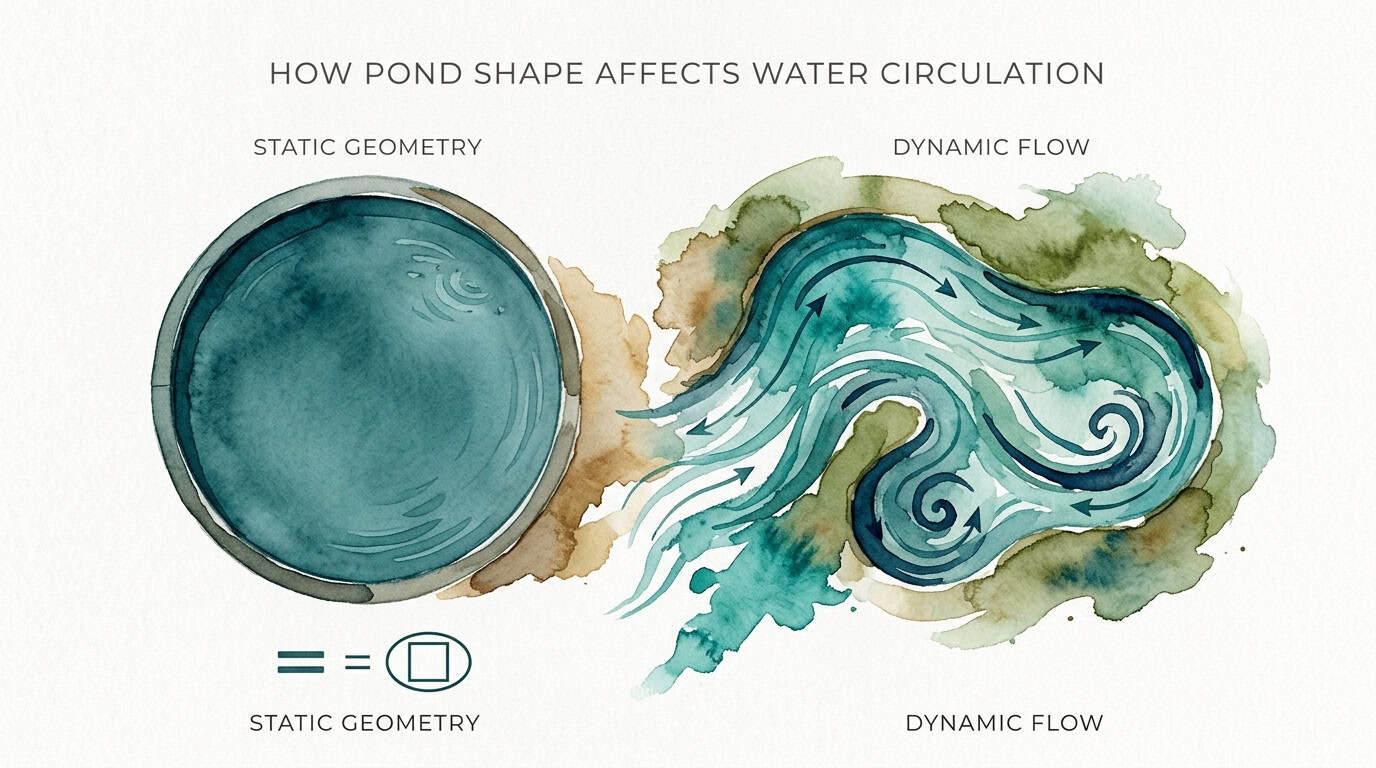
Your pond’s shape might be suffocating its life. Dead zones are the enemy of a healthy pond. When water stops moving, oxygen drops and algae takes over. Learn why smooth curves outperform sharp corners every time.
Pond shape dictates water circulation by determining the path of least resistance for flow and the location of hydraulic dead zones. Circular and oval geometries minimize friction and eliminate corners where water stagnates, promoting a continuous vortex that transports waste to drains. Conversely, rectangular or irregular shapes introduce turbulence and stagnant pockets, significantly reducing oxygenation efficiency and increasing the risk of thermal stratification and localized ammonia accumulation.
How Pond Shape Affects Water Circulation
Water circulation refers to the continuous movement of the entire volume of a pond, ensuring that oxygen, nutrients, and waste are distributed or removed uniformly. The geometry of the pond basin is the primary physical constraint on this movement. In a perfectly circular pond, water introduced at a tangent can maintain a rotating current with minimal energy input. This is due to the lack of 90-degree obstructions that would otherwise break the momentum of the fluid.
In many real-world applications, such as aquaculture and high-end koi keeping, the shape is selected specifically to maximize “sweep efficiency.” This metric measures how effectively the water current moves debris from the perimeter toward the center or toward a specific exit point, such as a bottom drain. When the shape is optimized, the mechanical system—the pumps and aerators—can operate at lower power levels while achieving superior water quality.

Geometry also influences the “hydraulic retention time” (HRT). This is the theoretical time a single molecule of water stays within the pond before being cycled through the filtration system. Irregular shapes often lead to “short-circuiting,” where water flows directly from the inlet to the outlet, leaving large volumes of the pond effectively stagnant. Technical design aims to eliminate these stagnant regions to maintain a homogenous environment.
The Fluid Dynamics of Pond Geometry
Understanding how water moves requires a look at fluid dynamics, specifically the interaction between moving water and the pond walls. In a rectangular pond, the corners represent areas of high friction and low velocity. As water moves along a straight wall and hits a 90-corner, it must change direction abruptly. This causes the flow to detach from the wall, creating turbulent eddies and slowing the overall velocity of the mass.
The Coand? effect is a critical principle here. It describes the tendency of a fluid jet to stay attached to a curved surface. In an oval or kidney-shaped pond, water injected along the edge follows the curve of the wall. This attachment allows the water to maintain its kinetic energy over a longer distance. This result is a more consistent “rotational flow” that keeps solids in suspension until they can be filtered.
Depth also plays a role in conjunction with shape. Vertical circulation is just as important as horizontal movement. A bowl-shaped bottom profile encourages “convectional mixing.” In this setup, denser, cooler water at the bottom is pulled toward a center drain or pushed upward by rising air from a diffuser. When the bottom is flat and the corners are sharp, this vertical exchange is inhibited, leading to a layer of anaerobic sludge at the base of the pond.
Benefits of Geometric Optimization
Designing a pond with a focus on hydraulic efficiency provides several measurable advantages for the ecosystem. The most immediate benefit is the elimination of “dead zones.” These are pockets of water where the dissolved oxygen (DO) levels drop to near zero. By ensuring a constant flow through every cubic inch of the pond, you prevent the localized buildup of toxic gases like hydrogen sulfide.
Another benefit is the reduction in mechanical workload. A pond with smooth, rounded edges requires less pump pressure to maintain a target turnover rate. In a rectangular system, you might need multiple returns or high-pressure jets to “push” water out of corners. An optimized shape allows gravity and centrifugal force to do a portion of the work. This translates to lower monthly electricity costs and less wear on pump motors.

Maintenance requirements also decrease when shape is prioritized. In a well-circulated circular pond, the current naturally funnels fish waste and leaf litter toward the center bottom drain. This “self-cleaning” effect means less time spent vacuuming the pond floor. It also ensures that the biological filter receives a steady stream of waste to process, preventing the sudden ammonia spikes common in ponds with stagnant areas.
Challenges of Non-Standard Shapes
While circular and oval shapes are technically superior for flow, they present practical construction challenges. Building a perfectly round concrete or liner pond is often more complex than digging a standard rectangle. It requires more precise excavation and, in the case of concrete, specialized forming or shotcrete application. Many builders default to rectangles because they are easier to measure and fit into traditional backyard landscapes.
Irregularly shaped ponds, such as those designed to look like natural lagoons, often suffer from “necking.” This occurs when a pond has a narrow channel connecting two larger areas. Circulation in these narrow zones is often high, but the larger basins on either side may become isolated from the main flow. This creates two separate ecosystems within the same body of water, making chemical treatments and filtration balancing much more difficult.
Linear ponds, or “raceways,” present a different set of challenges. While they are excellent for moving water in one direction, they often fail to mix the water column effectively. Debris tends to settle at the far end of the raceway if the flow velocity is not maintained at a high enough level. Balancing the flow rate to prevent “dead ends” without creating a current so strong it stresses the aquatic life requires precise mechanical calibration.
Limitations of Shape Alone
It is important to recognize that a good shape cannot compensate for an undersized pump or poor filtration design. Even the most perfectly designed circular pond will stagnate if the turnover rate is too low. Generally, a pond should have its entire volume passed through the filter once every hour. If the mechanical system is only moving the volume once every four hours, the geometric advantages of the pond are lost to simple lack of volume exchange.
External factors like wind and temperature also impose limits. Strong winds can create surface currents that oppose the intended circular flow of the pond. In very large ponds, wind-driven circulation can become the dominant force, rendering small tangential returns ineffective. Similarly, thermal stratification in deep ponds can create a “thermocline” that prevents top-to-bottom mixing, regardless of the pond’s perimeter shape.
Aquatic plants also act as physical baffles. If a pond is heavily planted with lilies or reeds along the edges, these plants will break the circular flow. They create micro-environments of stagnant water around their root systems. While plants are beneficial for nutrient uptake, their placement must be carefully considered so they do not act as “dams” that prevent the overall circulation of the water body.
Comparison: Static Geometry vs. Dynamic Flow
| Feature | Rectangular (Static) | Circular/Oval (Dynamic) |
|---|---|---|
| Circulation Efficiency | Low (Dead zones in corners) | High (Vortex-driven flow) |
| Waste Removal | Manual (Requires vacuuming) | Passive (Moves to center drain) |
| Construction Complexity | Low (Standard excavation) | Moderate to High |
| Oxygen Distribution | Uneven (Local hypoxia) | Uniform (Consistent DO levels) |
Best Practices for Circulation Setup
To maximize the benefits of your pond’s shape, the placement of inlets and outlets must be strategic. For a circular or oval pond, use “tangential pond returns” (TPRs). These are return jets placed 12 to 18 inches above the floor, angled to push water along the wall. This setup initiates a slow rotation of the entire water mass, known as a “centripetal flow,” which draws debris toward the center.
In rectangular ponds, the goal is to “round” the corners internally. This can be done by installing 45-degree corner baffles or by using large rocks and planting pockets to break up the 90-degree angle. Position returns at one end and the skimmer or drain at the opposite end to encourage a “plug flow” pattern. This ensures that the water moves like a conveyor belt, though it is still less efficient than a circular vortex.
Air diffusers should be placed at the deepest point of the pond. As the bubbles rise, they drag water from the bottom to the surface through a process called “airlift.” In a circular pond, placing the diffuser in the center works in harmony with the rotating current. In irregular shapes, you may need multiple, smaller diffusers located in known stagnant pockets to ensure those areas receive adequate vertical mixing.
Advanced Metrics: HRT and Flow Modeling
Serious practitioners often use “Hydraulic Retention Time” (HRT) to evaluate pond performance. The theoretical HRT is calculated by dividing the total pond volume by the pump’s flow rate. However, the “actual” HRT is often much lower due to dead zones. If your theoretical HRT is 1 hour but dye testing shows that 30% of the pond hasn’t moved after 3 hours, you have a major circulation failure.
Computational Fluid Dynamics (CFD) is a tool used by professional engineers to model water movement before a pond is even built. By inputting the pond’s dimensions and the locations of all returns and drains, the software can predict where stagnant zones will occur. For large-scale aquaculture or high-value koi collections, this modeling ensures that the investment in high-performance pumps isn’t wasted on a poorly shaped basin.
Another advanced consideration is the “Reynolds Number” of the flow. In most ponds, you want a “transitional” or slightly “turbulent” flow rather than a perfectly “laminar” one. While laminar flow is smooth, it does not mix the water column as effectively. A slight amount of turbulence, often created by aerators or waterfalls, helps break the boundary layer of water, facilitating better gas exchange at the surface.
Practical Scenarios
Consider a 5,000-gallon koi pond built as a perfect 10’x15′ rectangle with flat walls and a single bottom drain in the center. Because the corners are 5 feet away from the drain and at 90-degree angles to the flow, fish waste will inevitably pile up in those four corners. The owner must manually brush the corners weekly to prevent ammonia pockets.
Now, consider the same 5,000-gallon pond built as an oval. Two TPRs are installed at the narrow ends, angled to push water clockwise. The water follows the smooth curves of the walls, maintaining a velocity of 0.2 feet per second. This speed is enough to keep solid waste suspended until the rotating current brings it over the center drain. The result is a self-cleaning system with 20% higher average dissolved oxygen levels.
In a third scenario, an irregular “figure-8” pond is built. The narrow “waist” of the pond acts as a bottleneck. To fix the stagnation in the lower loop of the “8,” an additional pump is required just to move water from one side to the other. This increases the total energy consumption of the system by 40% compared to the oval design, simply to achieve the same water quality.
Final Thoughts
The shape of a pond is not merely an aesthetic choice; it is a fundamental engineering decision that affects the health of every organism within the water. Smooth, rounded geometries utilize the natural properties of fluid dynamics to maintain momentum and eliminate stagnant dead zones. By prioritizing flow efficiency during the design phase, you create a more stable, lower-maintenance ecosystem.
Mechanical systems like pumps and aerators should work in harmony with the pond’s shape, not against it. Tangential returns, center drains, and properly placed diffusers can turn a simple basin into a high-performance biological reactor. This mechanical optimization leads to higher dissolved oxygen levels, clearer water, and a more resilient environment for aquatic life.
For those planning a new pond or looking to improve an existing one, focus on the path the water takes. Identifying and eliminating areas where water stops moving is the most effective way to prevent long-term water quality issues. Whether through structural changes or strategic equipment placement, achieving dynamic flow is the key to a thriving pond.
Frequently Asked Questions About How Pond Shape Affects Water Circulation
Why are circular ponds considered the most efficient for water circulation?
Circular ponds are the most efficient because they minimize the friction and drag that occur when moving water hits a boundary. In a circle, there are no 90-degree corners to disrupt the momentum of the fluid. When water is injected at a tangent to the wall, it creates a continuous vortex. This rotating mass of water requires very little energy to maintain its speed. This movement ensures that the entire volume of the pond is constantly mixed, preventing the formation of stagnant dead zones and ensuring that waste is consistently directed toward a central bottom drain for removal.

Can I fix circulation issues in an existing rectangular pond?
Yes, circulation in a rectangular pond can be improved without a full rebuild. One effective method is to install “tangential pond returns” (TPRs) that are aimed to push water in a way that creates a circular flow pattern within the rectangle, essentially ignoring the corners. You can also “round off” the corners internally using large rocks, plant baskets, or submerged baffles. These structures prevent water from becoming trapped in the 90-degree angles. Additionally, placing air diffusers in the corners can provide the vertical lift necessary to move stagnant water back into the main current, though it is less efficient than a rounded design.
What are “dead zones” and why are they dangerous for fish?
Dead zones are specific areas in a pond where water circulation is non-existent or extremely limited. Because the water is not moving, it does not get exposed to the surface for gas exchange. Over time, the dissolved oxygen in these pockets is depleted by bacteria and fish respiration, leading to “hypoxia” or “anoxia.” In these oxygen-free environments, anaerobic bacteria take over, producing toxic byproducts like hydrogen sulfide and methane. If a pond “turns over” due to a storm or temperature change, these toxins can be suddenly released into the rest of the pond, causing immediate stress or death to fish and other aquatic life.
How does pond depth interact with shape to affect circulation?
Depth adds a vertical dimension to the circulation challenge. In a deep pond with a flat bottom, water can become “stratified,” where the top layer is warm and oxygen-rich while the bottom layer is cold and stagnant. A bowl-shaped or sloped bottom, combined with a circular perimeter, encourages the water to move in a “toroidal” (donut-shaped) path. This ensures that water from the very bottom is eventually pulled to the surface. Without this vertical exchange, even a perfectly round pond can have a “dead” bottom layer. Properly placed air diffusers are usually required in deeper ponds to assist the shape in maintaining vertical mixing.
Does the “Coand? effect” really apply to backyard ponds?
The Coand? effect is a fundamental principle of fluid dynamics that applies to any body of moving water. It describes how a stream of water will “attach” itself to a nearby curved surface and follow that curve. In a pond with rounded walls, this effect allows the water coming out of a return jet to “cling” to the perimeter and travel much further than it would in a straight line. This attachment keeps the water velocity high along the edges, which is where debris often settles. By leveraging the Coand? effect through smooth, curved transitions, you can maintain a much more effective “sweep” of the pond floor with less pump pressure.