

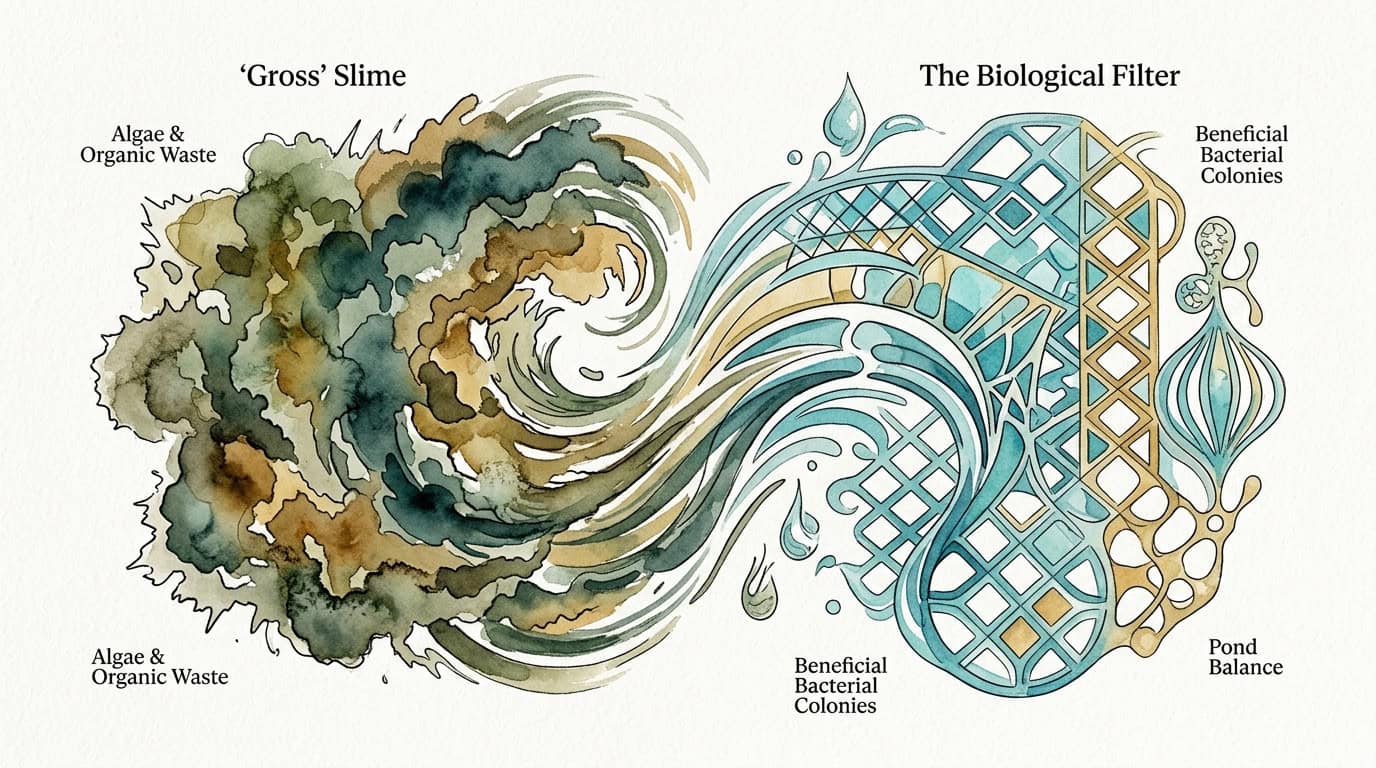
Before you scrub that rock clean, read this. That slippery coating on your pond rocks isn’t a problem—it’s a powerhouse filter. Biofilms are the unsung heroes of water clarity.
Beneficial biofilms keep ponds healthy by providing a living matrix for nitrifying bacteria that convert toxic ammonia into nitrite and then into relatively harmless nitrate. This biological layer also sequesters excess nutrients like phosphorus, inhibits the growth of pathogenic microbes through competitive exclusion, and acts as a primary food source for aquatic micro-organisms. These processes stabilize water chemistry and maintain ecological equilibrium in closed aquatic systems.
Biofilms represent one of the most successful life strategies on Earth. In a pond environment, they are not merely “slime” but complex, three-dimensional structures. These microscopic cities are composed of bacteria, algae, fungi, and protozoa, all held together by a self-produced glue called extracellular polymeric substances (EPS). This matrix allows the community to adhere to any submerged surface, from liner walls to volcanic rock.
The efficiency of a pond depends heavily on the health of these layers. While many hobbyists view a clean-looking pond as a healthy one, a sterile environment is actually a fragile one. Without a robust biofilm, ammonia spikes go unchecked and water quality degrades rapidly. Understanding the mechanics of these biological coatings is essential for anyone managing a serious water feature or aquaculture system.

Every surface in your pond is a potential site for biological activity. The total surface area of these biofilms determines the overall processing capacity of your ecosystem. By prioritizing the growth and maintenance of these films, you move from reactive pond management to a stable, self-regulating biological system.
How Beneficial Biofilms Keep Ponds Healthy
Beneficial biofilms function as the primary waste processing plant for the pond. They are primarily composed of autotrophic and heterotrophic bacteria that work in layers to break down organic matter. The primary role is the nitrogen cycle, where specific bacteria species reside within the EPS matrix to intercept dissolved wastes as water flows over them.
Beyond nitrogen processing, biofilms provide mechanical stability to the ecosystem. The EPS matrix acts as a biological filter, trapping fine suspended solids that are too small for mechanical filters to catch. Once trapped, these particles are slowly broken down by the community of microorganisms within the film, effectively mineralizing organic waste into inorganic components that plants can absorb.
In a healthy system, biofilms are found on every submerged surface. This includes the pond liner, rocks, gravel, and specifically designed filter media. In professional setups, the goal is to maximize the Specific Surface Area (SSA) available for biofilm attachment. The more surface area you provide, the larger the biological engine of the pond becomes.
Biofilms also serve as a protective barrier. A healthy, established biofilm occupies the “real estate” on pond surfaces, preventing opportunistic and pathogenic bacteria from gaining a foothold. This competitive exclusion is a critical factor in preventing diseases in fish and maintaining a balanced microbial population that resists sudden environmental shifts.
The Mechanics of Biofilm Development
The formation of a biofilm is a predictable, multi-stage process. It begins with the “conditioning” phase, where organic molecules like proteins and polysaccharides adhere to a surface. This occurs within minutes of a surface being submerged in pond water. These molecules change the surface charge, making it more attractive to colonizing microbes.

The second stage is primary colonization. Planktonic (free-swimming) bacteria encounter the conditioned surface and attach using hair-like structures called pili. During this phase, the attachment is reversible. If the conditions are not favorable—such as insufficient water flow or extreme pH—the bacteria may detach and seek a better location.
The third stage is irreversible attachment and the production of Extracellular Polymeric Substances (EPS). Once the bacteria decide to stay, they begin secreting the “slime” that characterizes biofilms. This EPS protects the colony from environmental stressors, including fluctuating temperatures, UV radiation, and even chemical treatments like algaecides.
As the colony matures, it develops a complex architecture. This is not a flat sheet; instead, it forms mounds and towers with “water channels” running between them. These channels are crucial for the delivery of oxygen and nutrients to the bacteria deep within the film and for the removal of waste products like carbon dioxide and ammonia.
The final stage is dispersal. When the biofilm becomes too thick or nutrients become scarce, parts of the colony detach and enter the water column as planktonic bacteria. These “scouts” then find new surfaces to colonize, ensuring the biological filter spreads throughout the entire pond system. This cycle keeps the biofilm young and metabolically active.
The Biological Filter: Nitrification and Beyond
The most critical function of a biofilm is nitrification. This is a two-step aerobic process performed by specialized bacteria. First, Nitrosomonas bacteria convert ammonia (NH3), which is toxic to fish, into nitrite (NO2). While nitrite is slightly less toxic than ammonia, it still poses a significant health risk to aquatic life.
The second step involves Nitrobacter or Nitrospira bacteria, which convert the nitrite into nitrate (NO3). Nitrate is significantly less toxic and is the preferred nitrogen source for pond plants and algae. This entire process is dependent on the availability of oxygen and a stable pH, as nitrifying bacteria are highly sensitive to environmental changes.
Heterotrophic bacteria also live within the biofilm. Unlike the nitrifiers, these bacteria consume organic carbon, such as fish waste, decaying leaves, and excess fish food. By breaking down these large organic molecules, they prevent the buildup of “muck” and sludge that can lead to anaerobic conditions and the production of toxic hydrogen sulfide gas.
Phosphorus sequestration is another vital role. Biofilms can actively take up phosphorus from the water column and store it within their biomass. This limits the amount of dissolved phosphorus available for free-floating planktonic algae (green water), helping to maintain water clarity through nutrient competition.
Advantages of Robust Biofilm Populations
A pond with a healthy biofilm is significantly more stable than one relying purely on mechanical filtration. The biological matrix provides a “buffering” effect against sudden changes in water chemistry. If a fish dies or a large amount of debris enters the pond, an established biofilm can scale its metabolic activity to handle the sudden increase in waste.
Energy efficiency is another measurable benefit. Biological filtration happens passively on every surface in the pond. While mechanical filters require pumps and electricity to move water through media, the biofilm on your rocks and liner is working 24/7 without additional power consumption. Maximizing “in-pond” biofilm reduces the load on external filtration systems.
Biofilms also contribute to the natural food web. They are a primary source of nutrition for grazing organisms like snails, tadpoles, and certain fish species. These organisms graze on the biofilm, keep it from becoming too thick, and recycle the nutrients back into the system in a more concentrated form.
Pathogen resistance is a key advantage. Research indicates that established biofilms can inhibit the growth of Aeromonas and Pseudomonas, common fish pathogens. By maintaining a healthy microbial community, you reduce the need for chemical interventions and antibiotics, which can be detrimental to the overall health of the pond.
Challenges and Common Pitfalls
The most frequent mistake pond owners make is the “spring scrub.” In an attempt to make the pond look pristine, owners often use pressure washers or stiff brushes to remove the brown or green film from rocks. This effectively destroys the pond’s biological filter, leading to immediate ammonia spikes and “new pond syndrome” in a mature system.
Oxygen deprivation is another common challenge. Nitrifying bacteria are aerobic, meaning they require oxygen to function. If the biofilm becomes too thick (over 2-3 mm), oxygen cannot diffuse into the deeper layers. This can lead to the death of the lower bacterial layers, causing the entire biofilm to slough off and cloud the water.
Chemical sensitivity is a major risk factor. Many common pond treatments, particularly those containing copper or strong oxidizers like potassium permanganate, are non-selective. While they may kill target algae or parasites, they also devastate the beneficial biofilm. A “clean” pond after chemical treatment is often a biological wasteland.
Inadequate surface area often limits biofilm effectiveness. In ponds with smooth liners and no gravel or rockwork, the available real estate for biofilm is minimal. This forces the system to rely entirely on external filters. If those filters fail or are cleaned too aggressively, the pond has zero biological backup, leading to rapid water quality failure.
Limitations and Environmental Constraints
Biofilm efficiency is heavily dependent on water temperature. Nitrifying bacteria see a significant drop in metabolic activity when temperatures fall below 50°F (10°C). While the biofilm remains intact during winter, its ability to process ammonia is greatly reduced. This is why overfeeding in late fall or early spring is particularly dangerous.
PH levels also dictate performance. The bacteria within the biofilm prefer a slightly alkaline environment, typically between 7.5 and 8.5. If the pH drops below 6.0, the nitrification process can stop entirely. This “pH crash” is often exacerbated by the nitrification process itself, which consumes carbonates and releases acid as a byproduct.
Wait times are a practical limitation. You cannot rush the development of a high-functioning biofilm. Even with commercial “bacteria in a bottle” starters, it takes 4 to 8 weeks for a biofilm to reach full maturity and stabilize. During this “cycling” period, the system is extremely vulnerable to fluctuations in fish load and feeding.
Excessive organic loading can overwhelm a biofilm. If the rate of leaf fall or fish waste exceeds the biofilm’s ability to mineralize it, the film will be buried under anaerobic sludge. Biofilms require a “clean” flow of oxygenated water to function; they cannot thrive when smothered by physical debris.

The ‘Gross’ Slime vs. The Biological Filter
It is important to distinguish between beneficial biofilms and problematic algae or fungal growths. While they may look similar to the untrained eye, their functions and impacts on the pond are vastly different.
| Feature | Beneficial Biofilm | Filamentous Algae (String Algae) |
|---|---|---|
| Appearance | Thin, slippery, brown/green velvet-like coating. | Long, green, hair-like strands or mats. |
| Primary Function | Nitrification and nutrient sequestration. | Nutrient uptake (but can clog pumps/filters). |
| Oxygen Impact | Consumes oxygen but stabilizes chemistry. | Produces oxygen by day; consumes heavily at night. |
| Maintenance | Leave undisturbed. | Manually remove if excessive. |
Understanding this comparison helps in making informed maintenance decisions. Beneficial biofilms should rarely be removed, whereas string algae may need periodic thinning if it begins to impede water flow or mechanical equipment. The presence of a healthy biofilm actually discourages excessive string algae by outcompeting it for nutrients.
Practical Tips for Biofilm Maintenance
To optimize your pond’s biological health, prioritize the protection of established surfaces. When cleaning mechanical filters, never use chlorinated tap water. Chlorine is designed to kill bacteria and will instantly neutralize the biofilm on your filter media. Always use pond water to rinse filter pads or bio-media.
Maximize surface area by using high-porosity media in your filters. Materials like ceramic rings, sintered glass, or specialized plastic media provide thousands of square feet of surface area in a small footprint. In the pond itself, adding a layer of river rock can significantly increase the “worksite” for beneficial bacteria.
Ensure consistent water circulation. Biofilms depend on the “boundary layer” of water—the thin layer of fluid immediately adjacent to the film—being constantly refreshed. Stagnant pockets in a pond will have poor biofilm performance and are likely to become anaerobic. Aim for a total pond volume turnover of at least once per hour.
Monitor your KH (carbonate hardness) levels. Nitrification consumes about 7.14 mg of alkalinity for every 1 mg of ammonia oxidized. If your KH drops too low, the biofilm’s activity will stall, and the pH will become unstable. Maintaining a KH of at least 100-150 ppm ensures the biofilm has the “fuel” it needs to process waste.
Advanced Considerations for Practitioners
For serious practitioners, managing the “diffusion limit” is key to maximizing biofilm efficiency. As a biofilm thickens, the rate at which oxygen and ammonia can penetrate the matrix decreases. In high-load systems, such as koi ponds or aquaculture tanks, using “Moving Bed Biofilm Reactors” (MBBR) is a superior strategy. In an MBBR, the media is constantly tumbled by air, which mechanically shears off excess biofilm, keeping the layer thin and highly active.
The concept of “bio-augmentation” can be used to recover a system after a crash. Introducing specific strains of bacteria—such as those adapted for cold weather or high organic loads—can help steer the biofilm’s development toward desired outcomes. However, remember that the environment dictates the community; if the conditions aren’t right, added bacteria will not persist.
Understanding the “C:N ratio” (Carbon to Nitrogen ratio) is critical for managing heterotrophic versus autotrophic balance. High levels of organic carbon (from fish waste or debris) favor fast-growing heterotrophic bacteria. These can quickly overgrow and smother the slower-growing nitrifying bacteria. Keeping the pond free of excessive physical muck is the best way to ensure the nitrifiers have the space they need to thrive.
Example Scenario: The Over-Cleaned Pond
Consider a 2,000-gallon pond that has been running for three years. The rocks are covered in a dark, velvet-like biofilm. The owner, wanting a “perfect” look for a summer event, drains the pond and power-washes every surface until the rocks look brand new. They refill the pond and return the fish immediately.
Within 48 hours, the fish become lethargic and stop eating. A water test reveals ammonia levels at 2.0 ppm—a lethal concentration. This occurred because the “biological engine” was physically removed. The system now has zero capacity to process the ammonia excreted by the fish through their gills.
To fix this, the owner must perform massive water changes to dilute the toxins and add a dechlorinator that also detoxifies ammonia. It will take weeks for the biofilm to re-establish. This scenario demonstrates that the “ugly” brown coating was actually the only thing keeping the fish alive. A better approach would have been a 20% water change and a light vacuuming of the pond floor, leaving the rock biofilms intact.
Final Thoughts
Maintaining a healthy pond is less about cleaning and more about cultivation. The beneficial biofilms on your pond’s surfaces are highly sophisticated biological units that perform the complex chemistry required to support aquatic life. By viewing these coatings as an asset rather than a nuisance, you can create a more stable and resilient ecosystem.
The key to success lies in providing ample surface area, ensuring high oxygen levels, and resisting the urge to interfere with the natural biological maturity of the system. A truly healthy pond is one where the biological processes are invisible but the results—clear water and healthy fish—are obvious.
As you continue to refine your pond management skills, focus on the microscopic level. When you protect the biofilm, you protect the entire system. This shift in perspective from mechanical aesthetics to biological efficiency is what separates a struggling pond from a thriving one.
Frequently Asked Questions About How Beneficial Biofilms Keep Ponds Healthy
What does a healthy pond biofilm look like?
A healthy, beneficial biofilm typically appears as a thin, slippery coating on rocks, liner, and equipment. Its color can range from light tan to dark brown or deep green. Unlike string algae, which forms long, flowing filaments, biofilm is a velvet-like layer that does not easily detach from the surface. It should feel slimy to the touch; this “slime” is the extracellular polymeric substance (EPS) that protects the bacterial colony. If the coating is thick, bubbly, or foul-smelling, it may have become anaerobic or be dominated by decaying organic matter rather than a healthy microbial community.
Can I have too much biofilm in my pond?
While biofilm is beneficial, excessive thickness can become a problem. In a healthy system, grazing organisms like snails and fish keep the biofilm at an optimal thickness. If the layer grows beyond 2-3 millimeters, oxygen can no longer diffuse to the bottom layers of the bacteria. This causes the lower layers to die and rot, which can lead to the entire biofilm “sloughing” off in large chunks, temporarily clouding the water and increasing the organic load. In filtration systems, too much biofilm can lead to “channeling,” where water bypasses the media entirely because the pores are clogged.
How long does it take for a beneficial biofilm to grow?
Biofilm begins to form almost immediately—within minutes of a surface being submerged. However, the development of a “mature” biofilm capable of fully handling the nitrogen cycle takes much longer. Typically, it takes 4 to 6 weeks for nitrifying bacteria (Nitrosomonas and Nitrobacter) to colonize a surface in sufficient numbers to stabilize ammonia and nitrite levels. This timeframe is temperature-dependent; in water temperatures below 60°F (15°C), the process can take significantly longer. During this period, it is vital to introduce fish slowly and monitor water chemistry daily to ensure the developing biofilm is not overwhelmed.
Does UV light kill beneficial biofilms?
A UV clarifier or sterilizer will not kill the beneficial biofilm attached to your pond’s rocks or filter media. UV light only affects organisms that pass directly through the UV chamber in the water column, such as planktonic algae (which causes green water) and free-swimming bacteria. Since the vast majority of beneficial nitrifying bacteria live attached to surfaces within the biofilm matrix, they are safe from the UV light. In fact, UV clarifiers can help biofilms by reducing the competition from planktonic algae, allowing more nutrients and oxygen to reach the beneficial bacterial colonies on the pond’s surfaces.
Should I ever clean the biofilm off my pond rocks?
Generally, you should never scrub or pressure-wash the biofilm off your pond rocks. Doing so removes the primary biological filter of your ecosystem and can lead to dangerous ammonia spikes. The only time you should remove these coatings is if they are smothered in anaerobic “muck” or heavy sludge that is preventing water and oxygen flow. Even then, you should only clean small sections at a time—no more than 25% of the surface area every few weeks—to ensure you don’t crash the pond’s biological stability. For aesthetic maintenance, a light rinse with pond water is usually sufficient.