

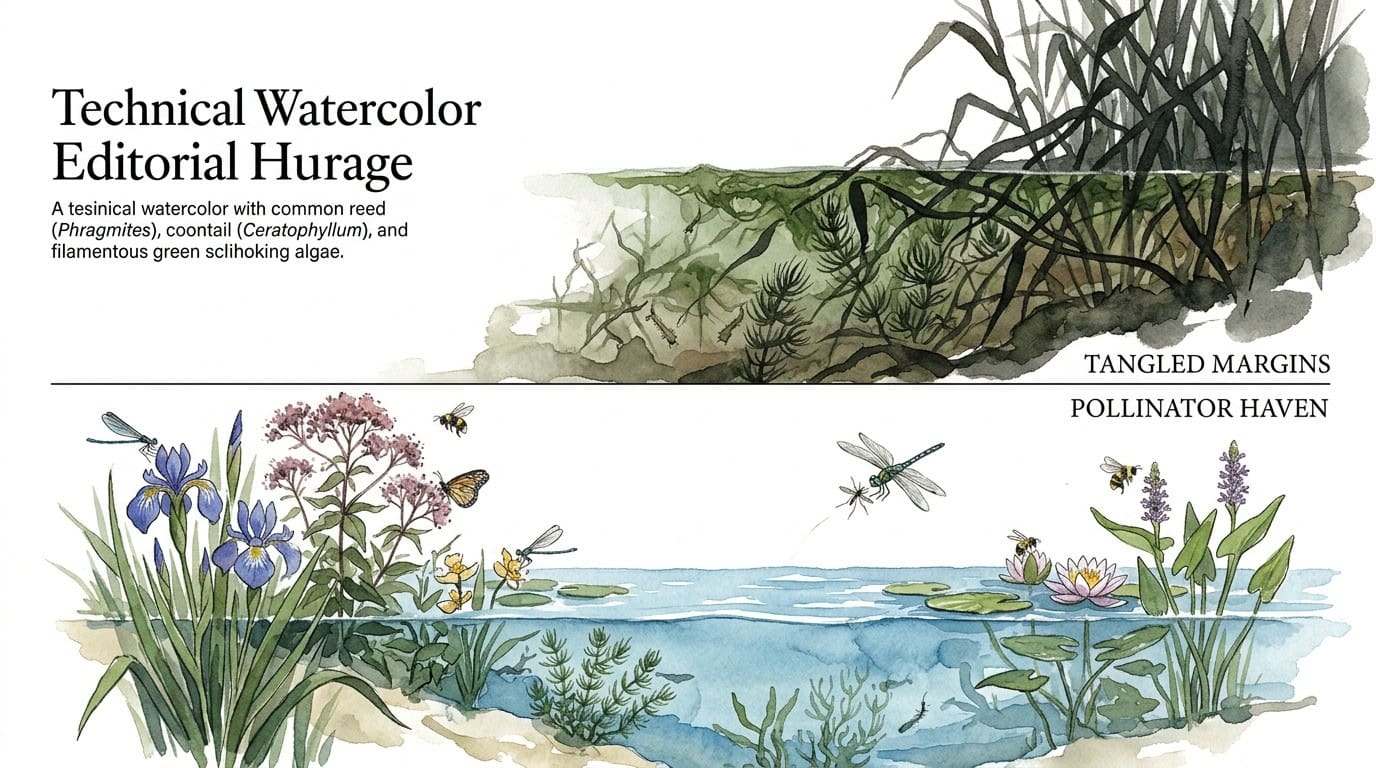
That ‘messy’ edge is actually a high-performance factory for water clarity and pest control. Don’t rip out your pond’s immune system! What look like ‘weeds’ are actually the home base for dragonflies—the ultimate mosquito hunters. This marginal zone isn’t a nuisance; it’s the biological engine that keeps your swim pond safe and clear.
Natural mosquito control for swim ponds is an integrated ecological strategy that leverages hydraulic movement and biological predation to eliminate mosquito larvae without chemical intervention. By maintaining constant water circulation and supporting a diverse community of aquatic predators like dragonfly nymphs and native fish, pond owners can disrupt the mosquito life cycle at its most vulnerable stages. This approach focuses on removing the stagnant, low-oxygen conditions required for egg-laying and larval development.
Natural Mosquito Control For Swim Ponds
Natural mosquito control in the context of swim ponds refers to a multi-layered biological and mechanical system designed to prevent Culicidae species from completing their life cycle. Unlike traditional swimming pools that rely on toxic levels of chlorine or bromine to sterilize the water, a swim pond utilizes a living “regeneration zone” to filter nutrients and outcompete pests. This system exists at the intersection of limnology and hydraulic engineering.
The primary reason for implementing natural controls is the maintenance of a healthy, swimmable ecosystem. Mosquitoes are attracted to stagnant, shallow water with high organic content and low dissolved oxygen levels. In a functional swim pond, these conditions are systematically eliminated. The system is used in residential and commercial eco-pools where chemical sensitivity, environmental conservation, and long-term sustainability are prioritized.

An effective analogy for this system is a high-performance engine. If the “oil” (water) is moving and filtered, and the “filters” (plants and predators) are clean, the system runs smoothly. If the water stops moving, the “engine” seizes, allowing mosquitoes to take up residence in the stagnant pockets. By engineering the pond to be “biologically full,” there is no ecological niche left for mosquitoes to occupy.
How It Works: The Mechanics of Biological Suppression
Natural mosquito control operates through three primary vectors: hydraulic disruption, biological predation, and environmental modification. Each layer must function in sync to ensure the pond remains larvae-free throughout the peak breeding season.
Hydraulic Disruption and Surface Tension
Mosquito larvae, often called “wigglers,” are dependent on the water’s surface tension to breathe. Most species use a specialized abdominal siphon to pierce the surface and exchange gases. Continuous water circulation—achieved through pumps, waterfalls, or aerators—breaks this surface tension. This mechanical disturbance makes it impossible for larvae to remain stationary at the surface, leading to drowning or exhaustion. Furthermore, female mosquitoes prioritize calm, stagnant water for egg-laying; moving water is a powerful behavioral deterrent.
Biological Predation (The “Mosquito Hawks”)
The most visible defense is the dragonfly. While adult dragonflies (the “mosquito hawks”) can consume hundreds of adult mosquitoes daily, their most significant impact occurs underwater. Dragonfly and damselfly nymphs are voracious aquatic predators that can spend up to several years in the larval stage. They actively hunt mosquito larvae in the marginal vegetation of the pond. Other beneficial insects include backswimmers (Notonectidae) and diving beetles (Dytiscidae), which patrol the water column and decimate larval populations before they can emerge as flying adults.
Nutrient Management and Biofilms
Mosquito larvae feed on organic debris, algae, and microorganisms found in stagnant water. In a swim pond, the regeneration zone—filled with gravel and specific aquatic plants—strips the water of excess nutrients (phosphorus and nitrogen). By limiting the food supply and fostering a healthy biofilm of beneficial bacteria, the pond becomes a nutrient-poor environment for mosquito larvae, further stunting their growth and survival rates.
Benefits of Natural Integrated Pest Management
The primary advantage of natural mosquito control is the elimination of synthetic pesticides. Chemical larvicides can have unintended cascading effects on the pond’s delicate balance, often killing the very predators (like dragonflies) that provide long-term protection. By relying on biology, the pond becomes more resilient over time.

Ecological stability is a significant measurable benefit. A pond that supports a diverse range of predators is less prone to “boom and bust” cycles of pests. Once established, these biological controls require zero manual input or cost, unlike chemical treatments that must be reapplied following rain or UV degradation. Furthermore, the presence of dragonflies, frogs, and native fish enhances the aesthetic and educational value of the swim pond, turning a maintenance requirement into a wildlife feature.
For the swimmer, the benefits are physical. Natural ponds provide “soft” water that is gentle on the skin, eyes, and hair. There is no risk of chemical residue, making these systems ideal for families with young children or pets who may ingest the water. The lack of mosquitoes around the pond perimeter also extends the usable hours of the outdoor space into the dusk and evening periods.
Challenges and Common Mistakes
The most frequent error in natural pond management is the creation of “dead zones.” These are areas where water circulation is blocked by dense vegetation or poor pond geometry. Even in a pond with high-powered pumps, a small pocket of stagnant water behind a rock or in a shallow cove can produce thousands of mosquitoes. Effective design requires that every cubic meter of water is subject to regular turnover.
Another common pitfall is over-clearing marginal vegetation. Property owners often mistake the “messy” plants at the edge for weeds and remove them to achieve a “cleaner” look. This effectively destroys the habitat for dragonfly nymphs and backswimmers, removing the pond’s primary biological defense. Without these predators, any small lapse in pump performance can lead to a mosquito outbreak.
Misidentifying “predatory” species can also lead to failure. For instance, while most frogs and toads are beneficial, their tadpoles are primarily herbivorous and do not eat significant amounts of mosquito larvae. Relying solely on frogs for mosquito control is a common misconception that often results in disappointment. Integrated management must include insect predators and water movement to be truly effective.
Limitations and Environmental Constraints
Natural control methods are highly effective but are not an instantaneous “kill” solution. Biological systems take time to reach equilibrium. A newly constructed swim pond may experience a mosquito spike in its first season before the predator populations (like dragonflies) have fully established. During this transition period, supplemental natural treatments may be required.
Temperature also plays a critical role. In extremely hot weather, the metabolic rate of mosquito larvae increases, allowing them to develop from egg to adult in as little as seven days. If the biological control agents are not yet at peak density, they may be “outpaced” by the mosquitoes’ rapid reproduction. Additionally, in very small ponds or container water features, the ecosystem may be too small to support a self-sustaining population of larger predators like dragonflies.
Environmental boundaries also exist regarding fish. While certain fish like fathead minnows are excellent for mosquito control, they also contribute to the pond’s nutrient load through waste production. In ultra-low nutrient “Type 1” swim ponds (which rely purely on plants), the introduction of fish can disrupt water clarity and lead to algae blooms. This requires a trade-off between pest control and extreme water transparency.
Comparing Control Strategies: Natural vs. Chemical
| Factor | Natural (Biological/Hydraulic) | Chemical (Chlorine/Pesticides) |
|---|---|---|
| Operating Cost | Low (Electricity for pumps only) | High (Continuous chemical purchase) |
| Environmental Impact | Positive (Supports biodiversity) | Negative (Can harm non-target species) |
| Maintenance Skill | High (Ecological understanding) | Medium (Chemical testing) |
| System Longevity | Increases over time as ecosystem matures | Static; requires constant intervention |
| Safety | Safe for all wildlife and humans | Variable; potential skin/eye irritation |
Practical Tips for Pond Optimization
To maximize the efficacy of your natural mosquito control system, follow these best practices for design and maintenance:
- Maintain Vertical Edges: Where possible, design the swimming area with steep or vertical walls. Mosquitoes prefer shallow water (less than 24 inches deep). By minimizing shallow shelving, you reduce the available breeding real estate.
- Select Native Marginal Plants: Use species like Pickerelweed (Pontederia cordata), Cardinal Flower (Lobelia cardinalis), and Arrowhead (Sagittaria). these provide the perfect perching and egg-laying sites for dragonflies and damselflies.
- Install Bottom-Diffused Aeration: While fountains are aesthetic, bottom-diffused aerators move the entire water column, ensuring no low-oxygen “dead zones” exist at the bottom where organic matter accumulates.
- Use Bti During Transitions: If you have a temporary outbreak, use Bacillus thuringiensis israelensis (Bti) dunks. This is a naturally occurring soil bacterium that specifically targets mosquito larvae without harming fish, pets, or humans.
- Avoid Excessive “Floating” Plants: While some lilies are fine, avoid covering more than 50% of the surface. Dense floating vegetation provides a “shield” for larvae, protecting them from surface agitation and predatory fish.
Advanced Considerations: The Role of the Regeneration Zone
For serious practitioners, the design of the regeneration zone is the most critical technical factor. This zone acts as a biological filter and a predator sanctuary. A high-efficiency regeneration zone uses a “down-flow” or “up-flow” system where water is actively pulled through layers of gravel and plant roots. This ensures that any mosquito larvae hatched in the shallow plant zone are eventually pulled into the filter media or exposed to predators in the water column.
Scaling considerations are also vital. For a swim pond to be self-regulating, the regeneration zone typically needs to be roughly 30% to 50% of the total pond surface area. This ratio provides enough habitat to support a predator density high enough to handle “emergency” mosquito influxes from neighboring properties. Monitoring dissolved oxygen (DO) levels is the professional’s way to gauge success; levels above 5 mg/L are generally hostile to the most troublesome mosquito species while supporting robust predator populations.
Example Scenario: The Zero-Larvae Residential Pond
Consider a 100-square-meter residential swim pond located in a humid temperate climate. The pond is designed with a 60-square-meter swimming area and a 40-square-meter regeneration zone. To ensure zero mosquito survival, the owner installs a variable-speed pump that ensures a total volume turnover every 4 hours.
In the regeneration zone, the water depth is kept at a consistent 12 inches, but the water is in constant motion. The edges are planted with native grasses and flowering marginals. Within the first year, three species of dragonflies are observed breeding. Despite a heavy mosquito presence in the surrounding woods, dip-net testing in the pond consistently shows zero Culex larvae. The combination of surface disruption and the high density of backswimmers in the plant roots creates a “biological wall” that the mosquitoes cannot penetrate.
Final Thoughts
Natural mosquito control for swim ponds is not about fighting nature; it is about harnessing it. By understanding the life cycle of the mosquito and the requirements of its natural enemies, pond owners can create a self-sustaining system that provides crystal-clear, pest-free water. The key lies in the balance between hydraulic movement and biological diversity.
As you experiment with your own pond, remember that the “messy” marginal zones are your greatest asset. Protecting these habitats ensures that your dragonfly population remains robust and your water remains safe. This technical, ecosystem-based approach represents the future of sustainable water management, moving us away from chemical dependency and toward biological harmony.
While the initial setup requires more careful planning than a traditional pool, the long-term rewards of a living, breathing ecosystem are incomparable. For those looking to deepen their understanding, exploring the specific nitrogen-fixing properties of aquatic plants or the hydraulic conductivity of different gravel substrates will further enhance your pond’s performance.
Frequently Asked Questions About Natural Mosquito Control For Swim Ponds
How long does it take for natural predators to control mosquitoes in a new pond?
In a newly constructed swim pond, it typically takes one full growing season for a stable predatory ecosystem to establish. Dragonflies, damselflies, and aquatic beetles must find the pond, mate, and allow their larvae to grow. During the first few months, the pond is most vulnerable because the water movement may not yet be perfectly balanced, and predator densities are low. To bridge this gap, many practitioners use Bti (Bacillus thuringiensis israelensis) dunks, which provide targeted larval control without disrupting the developing beneficial insect populations. Once the second season arrives, the established “resident” predators usually provide enough coverage to keep mosquito populations at near-zero levels without further assistance.
Do I need to add fish to my swim pond to keep mosquitoes away?
While fish are excellent mosquito predators, they are not strictly necessary if your pond has proper water circulation and a healthy population of predatory insects. In fact, in some high-clarity swim ponds (Type 1 or Type 2), fish are avoided because their waste adds nutrients that can trigger algae blooms. However, if your design allows for it, small native fish like fathead minnows or bluegill are voracious consumers of larvae. If you choose not to have fish, you must rely more heavily on hydraulic movement—ensuring no stagnant surface area—and a well-developed regeneration zone that supports high densities of dragonfly nymphs and backswimmers. In most functional ecosystems, the insects alone are enough to handle the workload.
Will a waterfall or fountain be enough to stop mosquito breeding?
A waterfall or fountain helps by creating surface agitation, which deters egg-laying and can drown larvae. However, these are often “local” solutions. A waterfall only disturbs the water in its immediate splash zone. For a swim pond to be truly mosquito-free, you need a comprehensive circulation system that eliminates “dead zones” across the entire surface. This is usually achieved through a combination of skimmers, bottom drains, and multiple return jets that create a consistent, slow-moving current throughout the pond. If a corner of your pond remains still and collects floating debris, mosquitoes will find it regardless of how large your waterfall is. The goal is total volume turnover and surface tension disruption everywhere.
Can mosquitoes breed in the plants of the regeneration zone?
This is a common concern because the regeneration zone is shallow and filled with plants—conditions mosquitoes usually love. However, in a well-engineered swim pond, the regeneration zone is the most dangerous place for a mosquito. The water in this zone is constantly being pulled down through the gravel or pushed up through the roots, creating a subtle but persistent flow that disrupts larvae. Furthermore, the dense network of plant roots is the primary habitat for dragonfly nymphs and aquatic beetles. These predators are concentrated in the regeneration zone specifically because it is where their food (mosquito larvae) would likely be. As long as the water is moving, the plants act as a trap rather than a nursery.

Does Bti harm the dragonflies or other beneficial insects in my pond?
No, one of the greatest advantages of Bti (Bacillus thuringiensis israelensis) is its extreme specificity. It is a biological control that produces toxins that only become active in the highly alkaline gut of certain fly larvae, specifically mosquitoes, black flies, and fungus gnats. It does not affect dragonflies, damselflies, frogs, fish, bees, or humans. This makes it the perfect “safety net” for natural swim ponds. You can apply Bti to manage unexpected spikes in mosquito activity without worrying about killing the long-term biological defenses you are trying to build. It is widely used in organic farming and sensitive wetland management for this very reason.